From Physical Production to the Provision of Performance-Based Services.
—— Revitalizing the Japanese economy through a paradigm shift in public investment and private sector business transformation.
We are moving away from an era that found value in the mere purchase and ownership of goods, characterized by a 'build-and-leave-it' mentality. Instead, by clarifying the difference between owning an asset and realizing its actual value, the world is shifting toward an era of purchasing the functions of assets as a service.
However, Japan's current economic revitalization is being driven by traditional government-led investment, with an overemphasis on the value of physical production (Monozukuri). As a result, private companies—which should inherently be generating innovation through competitive principles—have lost their incentive to change, falling into a 'boiling frog' syndrome.
This is exactly the result of a persistent 'misalignment from the outset' in Public-Private Partnerships, where the proper roles of the public and private sectors are incorrectly defined.
Office Kumagae supports the structuring of sustainable business schemes as lasting 'systems'—critical for driving economic growth in a new era and ensuring a legacy for the next generation.
The Challenge: Why does Japan's economic stagnation persist?
As the global economy transitions to a new growth framework rooted in performance-based services and private investment, Japan remains trapped in its past successes, overly fixated on traditional manufacturing and public investment.
The fundamental cause of this stagnation is a structural disconnect.
In Western countries: BPR that drove private sector structural reform, and the true Public-Private Partnerships established by the governments that supported it:
In the 1980s and 90s, amidst intensifying global competition in the manufacturing sector, Western companies adopted BPR (Business Process Re-engineering) to counter Japan's manufacturing excellence. The essence of BPR was to completely redesign corporate business processes and outsource non-core domains, thereby maximizing the added value of their core competencies.
Enterprises implementing outsourcing demanded that their service providers deliver 1) cost reductions and 2) quality improvements simultaneously. This necessitated a framework for standardizing outsourced services and assessing them by their outcomes.
During this same period, Western countries introduced public infrastructure service procurement models such as PPP/PFI, with the public sector taking the lead in standardizing Performance-Based Service Business. The performance-linked contracting methods established in public procurement were subsequently applied to private-sector outsourcing, leading to the rapid spread of systems that manage service quality through KPIs.
This new service model transformed the 'unstable characteristics' inherent in traditional services—namely, 1) intangibility, 2) heterogeneity, 3) inseparability, and 4) perishability—into a manageable business through standardization and performance metrics. As a result, in Western countries, the service procurement business accelerated even in business-to-business (B2B) transactions. This led to the continuous creation of high-value-added services, which became a new source of GDP growth.
This is precisely why it is called a 'Public-Private Partnership' (PPP): by dividing their respective roles in the reengineering of business processes (BPR), the public and private sectors successfully established a framework that generates a higher dimension of added value.
Structural Challenges in Japan's Private Sector (The Private Sector Trap): Failure to Adopt BPR Due to Fixation on Existing Business Models
Meanwhile, Japanese companies focused on improving manufacturing, attempting to enhance added value through the 'deepening of in-house production.' While companies like Toyota were exceptional cases that successfully heightened their competitiveness through internalization, most companies did not outsource their non-core domains. Consequently, performance-based service businesses failed to develop domestically.
Structural Challenges in Japan's Public Sector (The Public Sector Trap): The Limits of the 'Build-and-Done' Approach in Public Infrastructure Investment
Furthermore, rather than understanding the essence of service procurement through BPR as 'performance-based services,' the Japanese government misconstrued PFI as a system that enables Deferred Payment. As a result, PFI—which should ideally integrate private investment for facility development with performance-based services—has been operated as a mere 'deferred payment scheme for construction.' Consequently, the standardization of service performance remains unestablished as an institutional framework to this day.
While further integration with economic growth mechanisms driven by BPR (Business Process Innovation) is expected, we must recognize a stark reality: the public sector continues to drive massive investments on its own, leaving infrastructure and public services in a 'build-and-done' state, ultimately lacking the perspective needed to build a foundation for long-term economic growth.
https://office-kumagae.com/wp-admin/post.php?post=310&action=edit
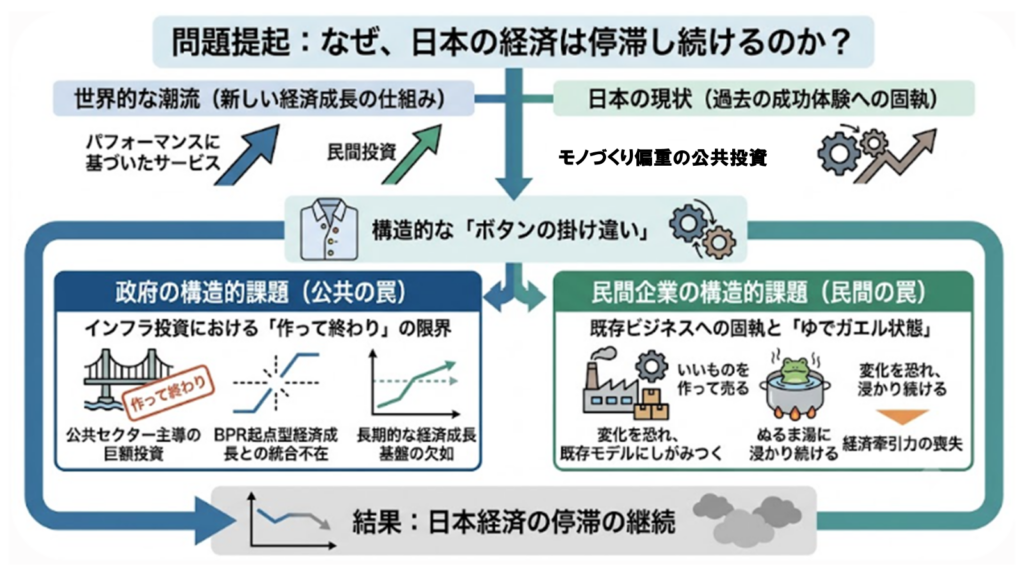
Office Kumagae confronts this structural stagnation head-on, providing advisory services to implement fundamental solutions (know-how) through the dual engines of the public and private sectors.
The Solution Framework: A Virtuous Cycle Driven by the Dual Engines of the Public and Private Sectors
The objective of Office Kumagae's support is not one-off financing or the mere reduction of initial costs. Rather, it is the construction of a business scheme as an 'institutional framework'—one where the procurer and the contractor enter into an optimal contract based on game theory, ensuring long-term service quality and creating a legacy reliably passed down to the next generation.
Currently, the government is proceeding with the introduction of large-scale public investment schemes in an effort to establish a sustainable growth cycle. However, it relies too heavily on its traditional manufacturing strengths, rooted in a 'build-and-done' mentality, and lacks the perspective of creating new businesses through the redesign of processes.
Japan's manufacturing excellence is highly acclaimed worldwide. For this very reason, this inherent strength should ideally be transformed into the service economy as the capability to guarantee long-term service quality. However, current public investments fail to foster the development of the service sector—an industry experiencing sustained growth globally—which serves as a contributing factor to the relative stagnation of the Japanese economy. If the public administration continues to execute public investments based on conventional thinking, private enterprises will remain unable to break free from their existing business models. Consequently, a prolonged impasse where no viable solutions can be found is likely to persist, leaving them trapped in a 'sell-and-done' structure.
The starting point for this change is a paradigm shift in the public sector. It is essential to fundamentally overhaul the existing Japanese-style PFI (facility development via deferred payment) and transition to an outcome-focused Performance Based Service Procurement (PBSP). Doing so will create a market where private operators can formulate bankable projects, thereby promoting private investment in public works.
If the public sector presents appropriate business opportunities and risk allocation, private companies can transform into a model that balances the 'long-term enhancement of service quality' with 'securing appropriate returns,' all while leveraging their manufacturing strengths. In other words, they can expand their manufacturing strength into a 'strength in service quality.
When the public sector demonstrates a growth model driven by BPR (Business Process Re-engineering), it triggers a paradigm shift within private enterprises, inducing a transition toward output-oriented business models. Only through this integration of 'manufacturing and services' can the sustainable growth of the Japanese economy truly be realized.
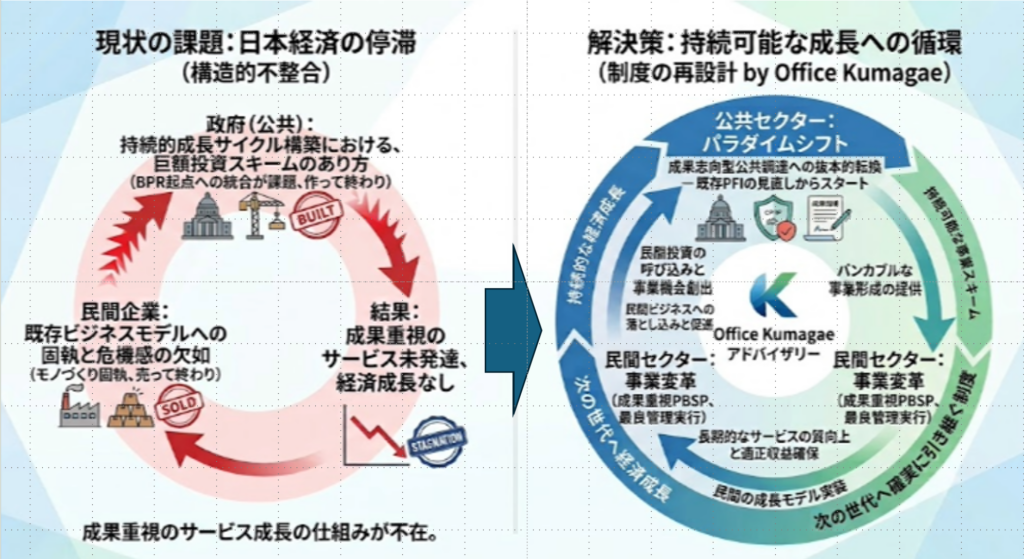
Office Kumagae provides comprehensive support for both "revising public sector procurement methods" and "structuring output-oriented service delivery systems for the private sector."
Our Approach
Public-Private Partnerships (PPP/PFI) are not merely collaborative business schemes between the public and private sectors.
PPP/PFI is the construction of an 'institutional framework' that converts public investment into private investment, transforming it into stable, long-term services grounded in the private operator's premise of a 'Going Concern' (the assumption of continuous business operations).
In this process, we support institutional design and structuring that clearly allocates the risks to be borne by the government and those reasonably transferred to the private sector, thereby maintaining and enhancing service quality over the long term. Because our approach is grounded in the 'Going Concern' principle, our objective is not merely to ensure the project's viability during the current contract period. Rather, our goal is to construct a mechanism that allows the business to be seamlessly handed over to the next contract period once the current one concludes.
Office Kumagae assists in designing optimal contract frameworks driven by game theory, empowering both clients and contractors to choose the most rational contractual arrangements. Consequently, this makes it possible to systematize the quality and performance of infrastructure—built upon Japan's globally praised Monozukuri (manufacturing excellence)—into a sustainable service provision model, strictly without burdening private enterprises with excessive risk.
Founder Profile
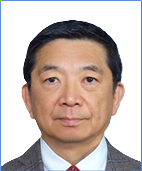
Hiroshi Kumagae, Representative of Office Kumagae / PPP Project Formulation Expert
Since joining Shimizu Corporation in 1984, Hiroshi Kumagae has been at the forefront of domestic and international infrastructure development and Public-Private Partnerships (PPP/PFI) for nearly 40 years. After serving as Director for the public sector at global consulting firms such as PwC, KPMG, and ABeam Consulting from 2000 onward, he established Office Kumagae in 2013. In the same year, he joined Crown Agents Japan, where he expanded overseas PPP projects utilizing the Grant Aid tied to Concession scheme. Most recently, as a JICA Expert assigned to the Directorate General of Infrastructure Financing (DGIF) at the Indonesian Ministry of Public Works, he led the structuring of highly feasible infrastructure finance schemes utilizing LVC (Land Value Capture)-Integrated models and Unified MRG (Minimum Revenue Guarantee) packages. He holds the APMG Certified PPP Professional (CP3P) Foundation certification and serves as the Chief Translator for the Japanese version of the official CP3P guide. He has made long-standing contributions to the advancement of PPP projects and capacity building both in Japan and globally.
Key Achievements & Areas of Expertise
- International Infrastructure Finance & PPP Advisory: Structuring bankable project schemes and designing risk allocation for large-scale toll roads, water supply, and waste-to-energy projects, alongside developing KPIs and integrating those indicators into payment mechanisms.
- Domestic Public Management Reform (BPR): Support for introducing the Designated Administrator System in central and local governments, formulation of basic plans for developing public facilities such as libraries and government office buildings, and assistance in planning and structuring outsourcing strategies.
- Domestic and International Institutional Design and Capacity Building: Planning and execution of certified training programs for the CP3P (Certified PPP Professional)—an international qualification for PPP experts—and support for establishing PPP legal frameworks for foreign governments, as well as national and local governments in Japan.
Professional Background
- Bachelor of Business Administration, Aoyama Gakuin University(1984) / Master in International Management (MIM), ESADE Business School(1991)
- Shimizu Corporation (Served in various roles including the International Division and as CFO of overseas operations)(1984-2000)
- Served as Public Sector Director at PwC, KPMG, and ABeam Consulting (2000-2013)
- Founder & Representative, Office Kumagae (2013 – Present)
- Senior Advisor at Crown Agents Japan Limited (2013-2024)
- JICA PPP Formulation Expert for Directrate General of Infrastructure Finance(DGIF)of Public Works Department of Indonesian Government.(2024-2026)
Certifications & Publications
- APMG Certified PPP Professional (CP3P) Foundation 2017 Certificate Number 04094250-01-NI36
- Publication :(Sole Author)
- Recommendations for Escaping from "Japanese-Style PFI" (Reiwa Edition): The Urgent Transition to Service Procurement (Nikkan Kensetsu Kogyo Shimbunsha) ISBN- 978-4809686733
- Recommendations for Escaping from "Japanese-Style PFI": Uncovering the True Nature of PFI through Risk Transfer (Nikkan Kensetsu Kogyo Shimbunsha) ISBN- 978-4782407059
- Handbook for Public Sector Management Reform (Chuokeizai-sha) ISBN- 978-4502397400
- The list of published articles, blog posts, and other resources.