Chapter 1: Introduction
During the "Lost Three Decades," Japan has been left behind by global economic growth. Compounded by the ongoing depreciation of the yen, the import-dependent domestic market is being severely impacted by rapid price surges. The daily lives of citizens are approaching a breaking point under these inflationary pressures. Furthermore, as priority is given to disaster relief for earthquakes and extreme weather events, the already limited government budget is becoming increasingly strained, leaving little to no fiscal capacity for essential inflation countermeasures.
The government has introduced initiatives to stimulate the economy, yet these differ little from previous efforts, leading to a steady decline in support for the highly anticipated Takaichi administration. A driving factor behind this chronic stagnation is Japan’s inability to let go of its past glory as the world's top manufacturer. By remaining trapped in the simplistic assumption that Japan's strength = manufacturing, the country has essentially choked off its own avenues for economic growth.
Of course, there is no doubt that Japan's manufacturing capabilities are world-class. The problem, however, lies in misjudging the direction for evolving this strength into the next phase. The true essence of manufacturing goes beyond merely producing goods; it holds the inherent power to be elevated into a service model that guarantees long-term performance and quality.
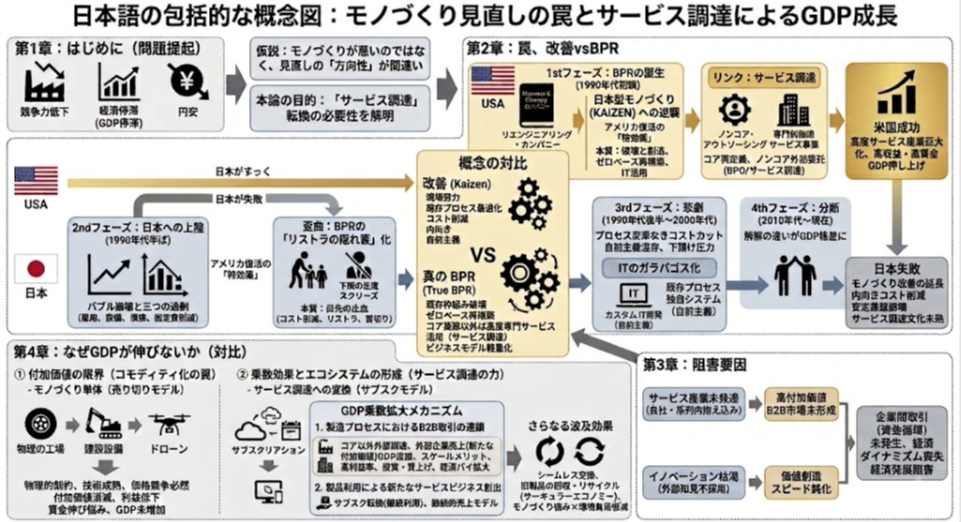
How, then, can manufacturing evolve into this next phase? We will explain the answer from the perspective of introducing Performance-Based Service Procurement.
- Current Challenge: Japan's competitiveness in the global market is declining, and prolonged economic stagnation (sluggish GDP growth) is driving the depreciation of the yen.
- Proposed Hypothesis: We believe the root cause is not that manufacturing (Monozukuri) itself is flawed, but rather that Japan took the wrong direction in re-evaluating its approach to it.
- Core Objective: We will demystify the mechanisms behind why the urgent shift to Service-Based Procurement is critical.
Chapter 2: The Pitfall of Re-evaluating Manufacturing — The Critical Distinction Between Kaizen and BPR
Delving into the history of Business Process Reengineering (BPR) reveals facts that directly corroborate our problem statement: Japanese companies conflated BPR with Kaizen, leading to their failure to transition to Service-Based Procurement.
First, we will break down the history of BPR into four phases and clarify how it is linked to Japan's prolonged stagnation. 解説:
Phase 1: The Birth of BPR — The U.S. Counteroffensive Against "Japanese-Style Manufacturing (Kaizen)" (Early 1990s)
BPR is a concept devised by American companies to stage a comeback from rock bottom after being battered by the Japanese manufacturing industry in the 1980s (epitomized by Kaizen and the Toyota Production System).
- Proponents & The Concept: The concept was first introduced in 1990 by Professor Michael Hammer of the Massachusetts Institute of Technology (MIT) and his colleagues, and it became a global phenomenon following the publication of their 1993 book, Reengineering the Corporation.
- The Essence is "Destruction and Creation": U.S. companies realized they could never catch up simply by imitating Japan's front-line, bottom-up approach of "incremental improvement (Kaizen)." Therefore, they adopted a method to fundamentally review existing business processes from a zero-base and dramatically reconstruct them top-down by leveraging IT. This fundamental "review of business processes" is exactly what BPR (Business Process Reengineering) is.
- Link to Service Procurement: At this time, U.S. companies redefined their "core competencies" and began boldly outsourcing all other functions (non-core operations) to specialized external firms (e.g., BPO: Business Process Outsourcing). This marked the definitive starting point for the rapid growth of advanced service industries in the West (which served as the foundational providers for service procurement).
Phase 2: Arrival in Japan — The Collapse of the Bubble Economy and the "Beginning of the Misconception" (Mid-1990s)
1. The Emergence of the "Three Excesses" Following the Collapse of the Bubble Economy (Background)
The collapse of the bubble economy began in January 1990. Operating on the assumption of uninterrupted growth during the bubble era, Japanese companies had massively bloated their organizations, personnel, and facilities. However, with the burst of the bubble in the early 1990s, sales plummeted. As a result, companies were saddled with heavy fixed costs in the form of "excess employment, excess capacity, and excess debt." To survive, they were urgently forced to slash this bloated cost structure.
2. Adopting BPR as the "Miracle Cure for America's Revival" (Motivation)
Around the exact same time (circa 1993), the U.S. economy, which had hit rock bottom after its defeat by Japanese firms, was roaring back to life. BPR was heavily touted in business magazines as the driving force behind this remarkable comeback. Unable to escape the lingering damage of the collapsed bubble, and gripped by a sense of crisis that traditional Kaizen was no longer sufficient, Japanese executives jumped at the concept. Viewing it as the "magic wand (silver bullet) that would save our companies," they eagerly imported BPR en masse.
3. The Tragic Consequence: BPR Twisted into a "Cover for Job Cuts" (The Distortion)
This is the most critical point. The original purpose of BPR in the United States was "the reconstruction of processes and business models to maximize added value for the customer (focusing on core competencies and leveraging Service-Based Procurement for non-core functions)."
However, immediately following the collapse of the bubble economy, the top priority for Japanese companies was not "value creation," but rather "stopping the immediate bleeding (cost reduction)". Consequently, BPR's radical catchphrase of "reviewing operations from a zero-base" became highly convenient for management, serving as a perfect pretext to cut into traditional sanctuaries (such as lifetime employment and keiretsu networks), enforce layoffs, and squeeze subcontractors. In short, right at the moment when Japan managed to import this cutting-edge "process reform methodology," the reality was that the term BPR was merely hijacked as a "smokescreen for simple restructuring (layoffs and cost cuts)" to pay the bill for the bubble era.
Phase 3: The Resulting Tragedy — Layoffs and the Preservation of the "In-House First" Mentality (Late 1990s – 2000s)
This distorted, uniquely Japanese version of BPR led to the worst possible consequences.
- Cost-Cutting Without Process Reform: Authentic BPR inherently pairs "process redesign" with "leveraging external services." However, Japanese companies preserved their existing processes and the "in-house first" mentality (the structure of handling everything internally). They merely executed "personnel reductions (layoffs)" and "cost-reduction demands on subcontractors," all while labeling these actions as "BPR."
- The "Galapagosization" of IT: While the U.S. standardized its processes and implemented external packages (services) such as ERP (Enterprise Resource Planning), Japanese companies custom-built (developed from scratch) IT systems specifically to fit their "existing (and inefficient) processes." This, too, was a manifestation of the "in-house first" mentality, and an act of willingly abandoning the opportunity to procure superior, standardized external services.
It is reasonable to conclude that Japan's "Lost Three Decades" essentially started from this exact point.
Phase 4: The Decisive Divide Between Japan and the U.S. — The Growth Gap in the Service Industry (2010s – Present)
The difference in how BPR was interpreted translated directly into a disparity in macroeconomic performance (GDP).
The Historical Misunderstanding of BPR — Why Japan Failed to Transition to "Service-Based Procurement"
- The United States (The Success of BPR): As companies aggressively outsourced their non-core operations, advanced B2B service industries—such as IT, HR, accounting, consulting, and logistics—experienced massive growth. Because service providers were able to leverage economies of scale, they achieved high profitability and high wages, which in turn significantly boosted the nation's GDP.
- Japan (The Failure of BPR): In contrast, Japanese companies continued to inward-lookingly slash costs as an extension of "manufacturing improvement (Kaizen)." As a result, even though they dismantled the stable foundation of lifetime employment—their traditional strength—they failed to foster a culture of "Service-Based Procurement" to leverage advanced external expertise. Furthermore, the external service sector, which should have been the foundational provider, failed to invest in itself, accepting a role as mere "cost-cutting tools for major corporations." Consequently, a high-value B2B service market like those in the West never materialized. This left the service industry—employing roughly 70% of Japan's workforce—trapped in a structure of "underbidding," leading to chronic low profitability that dragged down wage levels across the nation. As a natural consequence, personal consumption, which accounts for about 60% of GDP, completely chilled.
In essence, the "suppression of Service-Based Procurement driven by an overemphasis on cost-cutting" went far beyond a simple strategic error by individual firms. Manifesting as the collapse of stable employment, the stagnation of service sector productivity, and the breakdown of the consumption and growth cycle, it ultimately became the greatest structural bottleneck that created Japan's "Lost Three Decades."
As this demonstrates, it becomes clear that the misconception surrounding "Kaizen" and "BPR" was not merely a difference in strategic interpretation, but rather the historical turning point that divided the economic growth of Japan and the United States.
- The Limits of "Kaizen" (Continuous Improvement): The Kaizen (continuous improvement) at which Japanese companies excel is essentially the "optimization of existing processes" and "cost reduction" through grassroots efforts. These activities are inherently "inward-looking" (focused within the company or department), and they foster a tendency to internalize every function in an effort to achieve efficiency.
- The True Definition of "BPR" (Business Process Reengineering): It entails shattering the status quo and "reconstructing business processes from a zero-base." This approach involves leveraging highly specialized external services for non-core functions (i.e., Service-Based Procurement) to make the business model itself leaner and more robust.
- The Resulting Tragedy: Under the banner of "BPR," Japanese companies essentially carried out a massive, company-wide "Kaizen" (cost-cutting) exercise that required zero investment. Consequently, they squandered the opportunity to elevate their value proposition by procuring advanced external services, ultimately leading to the "suppression of Service-Based Procurement."
Chapter 3: The High Cost of Reluctance: How the Suppression of Service Procurement Has Stalled Japan's Economy
Japan’s long-standing failure to fully leverage Service-Based Procurement has evolved into a structural issue that extends far beyond a decline in micro-level (corporate) competitiveness, ultimately resulting in macro-level (the entire Japanese economy) stagnation. This progression can be summarized as follows:
1. Underdevelopment of the Service Industry: The structural problem caused by companies failing to procure external services.
Japanese companies, trapped by their past success of achieving global dominance in manufacturing, interpreted the essence of BPR merely as "improving processes to cut costs." Consequently, they intensified cost-cutting efforts across all processes, including the non-core service processes they kept in-house.
As a result:
- highly specialized B2B services (such as SaaS, specialized consulting, and niche outsourcing) failed to develop sufficiently,
- and the "high-value-added service market" that expanded across the West failed to emerge in Japan,
- thereby impeding the maturation of a "service-based economy" predicated on the inter-corporate circulation of capital.
2. The Depletion of Innovation: Stagnation caused by the failure to integrate external expertise.
In an environment of long-standing institutional constraints and the protection of existing businesses, viable options to utilize external services failed to develop sufficiently. Consequently, Japanese companies found themselves in a position where driving process improvements in-house tended to be the relatively rational choice.
Due to this structure, opportunities to integrate heterogeneous external insights were systemically restricted. Consequently, innovation leveraging external services—such as those outlined below—stagnated, ultimately slowing down the overall speed of new value creation.
- Operational innovation via SaaS
- Business redesign through specialized consulting
- Efficiency optimization via outsourcing
- Business sophistication through data analytics services
3.The Result: The absence of B2B transactions and the loss of economic dynamism
The underdevelopment of the service industry prevented an increase in B2B transactions and weakened the circulation of funds, ultimately depriving the broader economy of its dynamism.
This is not merely an isolated problem for individual companies; it is the structural factor that brought about the prolonged stagnation of the Japanese economy.
4.Barriers to New Entry Due to Institutional Constraints: A structure that prevents the integration of external insights, even when desired.
The failure of Japanese companies to utilize external services was not merely a result of their preference for internalization; it was heavily influenced by the government's continued regulation of new market entrants to protect the vested interests of existing businesses.
For example, prohibiting unlicensed taxis once made a degree of sense for safety when licensing matched supply with demand; today, however, the system effectively shuts out demand-driven entry by ignoring the severe shortages in rural areas and forcing ride-sharing platforms—which natively secure safety through their own tech—to comply with outdated rules designed for traditional taxi companies.
Historically, public procurement protocols and sectoral regulations have prioritized incumbent preservation, systematically impeding the market entry of innovative services and nascent enterprises. Consequently, irrespective of corporate intent to assimilate external expertise, an institutional paradigm was entrenched wherein external service adoption was rendered impossible due to the following factors:
- ・Regulatory constraints prohibited the commercialization of novel services.
- ・Startups failed to clear outdated procurement hurdles.
- ・Bureaucrats had no metrics to evaluate innovative offerings.
5. Institutional Constraints in the Payment Sector: The preservation of cash and the inefficiency of fragmented e-money
Institutional constraints are also glaringly evident in the payment sector. In Japan, cash usage has been preserved for years. While entry into the e-money market was relatively unrestricted, it led to a proliferation of platforms—such as Suica, PASMO, Edy, WAON, nanaco, and PayPay—creating a highly fragmented landscape where standardization and interoperability failed to progress.
While a localized, non-standardized approach once successfully fueled technological leaps in Japan’s manufacturing past, continuing to leave this structure unchecked in today’s era of global ISO standardization must be deemed a "critical error of omission by the government."
By neglecting to mandate essential standardization—and while there may have been some technical evolution regardless—cash-centric customs and legacy ATM networks were kept alive as the default baseline, directly preserving the vested interests of incumbents. Simultaneously, e-money providers deliberately dodged interoperability to defend their own "walled gardens," spawning a chaotic over-proliferation of digital wallets.
As a result, retailers are forced to absorb the costs of integrating disparate payment systems, leaving consumers with a subpar experience. Is it not fair to say that these structural roadblocks are actively suffocating the external service sector, acting as a "massive drag" on Japan’s macro-level digitalization and operational efficiency?
6. The Failure of the Public Procurement Paradigm Shift: How Misconstruing PFI as "Construction" Robbed Japan of its Transition to a Service Economy
Globally, systems to manage public service quality via KPIs became standardized. Public procurement underwent a paradigm shift toward Performance-Based Service Procurement (PBSP), with countries like the UK, Australia, and Canada publishing official PBSP guidelines.
In Japan, however, this paradigm shift was entirely misunderstood. Although PFI—pioneered in advanced nations—was fundamentally a "service procurement method leveraging private investment," the Japanese government misconstrued it as a mere "mechanism to construct public facilities using private funds." Consequently, the government failed to implement the "standardization of service procurement" that was strictly necessary when introducing PFI. In doing so, it failed to fulfill its role in making the private sector recognize the critical importance of deploying PBSP business models in the B2B market.
As a result, private companies lost the opportunity to pivot toward a service economy based on the already globally standardized PBSP model. Ultimately, the Japanese economy remained trapped in prolonged stagnation, heavily biased toward a traditional manufacturing mindset—a legacy structure inherently resistant to standardization and interoperability.
7. Now is the Time to Revise PFI Guidelines and Accelerate the Transition to PBSP
To recover from the more than 25 years lost due to the initial misunderstanding of BPR, the Japanese government must fundamentally overhaul the PFI Act, the PFI Basic Policies, and related guidelines to robustly promote the adoption of PBSP.
It is never too late.
- PBSP is precisely the mechanism needed to elevate the inherent strengths of Japanese enterprises—their manufacturing quality and technological prowess—into sustainable, long-term service performance.
- By ensuring that both the public and private sectors fulfill their respective and appropriate roles, it is entirely possible to forge a powerful new growth engine for the Japanese economy.
Chapter 4: Why Does "Standalone Manufacturing" Fail to Generate GDP Growth Compared to the "Transition to Service Procurement"?
Below, we contrast the differing mechanisms of economic growth (GDP expansion) between the two models.
- ① The Limits of Value Creation (The Commoditization Trap)
- ・Standalone Manufacturing: Constrained by physical limits (e.g., raw material and logistics costs), this sector inherently falls into price wars as technology matures. In a traditional "sell-once" model, there is a hard physical limit to cost reduction. As technology matures and products commoditize, price competition inevitably ensues, completely eroding added value. Consequently, companies miss opportunities to provide new services or value, corporate profits decline, wage growth stagnates, and the nation’s overall added value (GDP) fails to expand.
- ② The Multiplier Effect and Ecosystem Formation (The Power of Service Procurement)
- Transition to Service Procurement: By converting activities previously internalized as "internal costs" into externally procured "services," new specialized service businesses are established.
- GDPが乗数的に拡大する理由: これには、大きく2つのメカニズムが働きます。 第一に、製造プロセスにおけるB2B取引の連鎖です。コアコンピタンス以外の業務を外部から調達することで、内部のコスト削減に留まらず、外部企業の売上(新たな付加価値)としてGDPに追加されます。各サービス企業がスケールメリットを活かして高い利益率を出し、投資や賃上げを行うことで、経済全体のパイが拡大していきます。このノンコア業務の外部調達への転換は、民間事業者の自発的なコスト削減の意思決定を待つだけでなく、経済活性化の施策を行う政府のサポートが有効です。
- 第二に、出来上がった製品を利用した新たなサービスビジネスの創出です。製品を「売り切り」にするのではなく、継続利用およびアップグレードを前提としたサブスクリプション型へ転換することで、ビジネスは継続的に売上を拡張させるモデルへと進化します。
- さらなる波及効果(エコシステムの形成): さらに、このモデル転換は社会的なエコシステムも形成します。製品をサービスとして提供し、シームレスに新製品へ交換し続けるビジネスモデルは、旧製品の確実な回収とリサイクルを可能にします。これにより、モノづくりの強みを生かしながら、環境負荷を下げる循環型経済(サーキュラーエコノミー)をも実現することができるのです。このエコシステムの形成は、企業同士を競争させて市場を拡大・成長させていくというこれまでの政府の施策から、「優れた民間企業が、継続的・効率的かつ高収益を生み出せるエコシステムによってSustainableなビジネスを構築し、価格競争から抜け出して業種のリーダーになっていくことで市場を成長させる」という施策に転換することで可能になるものです。
以下に二つの大手民間企業におけるPBSPモデルを紹介しますが、このようなビジネスモデルを中小企業にまで拡大するためには、公共調達においてPBSPモデルを標準化し、民民間においても事業展開できるような政府のサポートが必要だと考えます。
具体例1:ミシュラン(仏)の「タイヤ・アズ・ア・サービス」
- ミシュランタイヤが新興国の安価なタイヤとの「価格競争(コモディティ化)」から脱却した見事なモデルです。
- 以前のモデル(モノ売り): 運送会社に大型トラック用のタイヤを「売り切り」で販売。タイヤがすり減ったら新しいものを買ってもらう。しかし、新興国メーカーの安いタイヤとの激しい価格競争に巻き込まれていました。
- 新しいモデル(サービス調達とエコシステムの構築): タイヤを売るのではなく、「走行距離(走った分だけ課金)」というサービスを売るモデル(Michelin Fleet Solutions)へ転換しました。
- 【3つのエンジンへの合致】
- 外部サービス調達によるB2Bの連鎖: 走行距離やタイヤの摩耗状況をリアルタイムで把握するため、外部のIoTセンサー企業、通信会社、クラウドデータ解析企業などから高度な「サービスを調達」し、自社のビジネスに組み込みました。これによりIT産業などの新たな需要(GDP)が創出されています。
- 継続売上(サブスク化): 運送会社は「タイヤ購入費」という初期投資がなくなり、「走行距離に応じた月額利用料」を払うだけになります。ミシュランにとっては安定した継続売上となります。
- 旧製品の回収とリサイクル(サーキュラー): タイヤの「所有権」はミシュランにあるため、限界まですり減る前に確実に自社で回収します。回収したタイヤの表面を貼り替える(リトレッド)ことで、新品同様にして再利用し、物理的な製造コストと環境負荷を劇的に下げました。
具体例2:コマツ(日本)の「スマートコンストラクション」日本のインフラ・建設機械業界における大成功事例
- 「建機そのものの改善(Kaizen)」から、「工事現場全体のBPR」へと視座を引き上げ、外部サービスを巻き込んだ好例です。
- 以前のモデル(モノづくりとKaizen): 「壊れない」「燃費が良い」「馬力がある」という建機自体のハードウェアの改善(Kaizen)を重ね、建設会社に建機を販売(またはリース)して終わりでした。
- 新しいモデル(サービス調達とエコシステムの構築): 「建機」を売るのではなく、建設現場の「施工の最適化・効率化」というサービスを提供するモデルへ転換しました。
- 【3つのエンジンへの合致】
- 外部サービス調達によるB2Bの連鎖: 自社で全てを開発するのではなく、測量のためのドローンサービス企業、地形データを処理する3D解析ベンチャー、現場の工程管理を行うソフトウェア企業など、外部の専門サービスを積極的に調達・連携(オープンイノベーション)しました。これにより、巨大な「建設DX」というエコシステムと新たな市場が生まれました。
- 継続売上(サブスク化): 顧客は「ドローン測量〜3Dデータ作成〜ICT建機の制御」という一連のプロセスを、プラットフォーム(LANDLOG等)を通じて継続的に利用し、そこに課金する仕組みを構築しました。
- ビジネスモデルの再定義(エコシステム): 単に自社の建機を売るだけでなく、他社の古い建機に「後付けのIoTデバイス(外部調達品)」を取り付けるサービスも提供することで、現場全体のデジタル化と稼働率向上を支援しています。
第5章:結論 —— サービス調達の導入が急がれる理由
- まとめ
「自社内でのモノづくりの改善」という内向きのベクトルから、 「外部サービスを高度に調達・統合し、新たな価値を創出する」という外向きのベクトルへ転換しなければ、BPRとは呼べません。 この転換こそが、日本企業が再び成長軌道に乗るための必須条件です。 - 今後のアクション(企業側)
- 経営層が「改善」と「BPR(外部サービスの積極活用)」の違いを正しく認識すること。
- コア業務とノンコア業務を仕分けし、ノンコア・高度専門領域における「サービス調達」を解禁・推進すること。
- 今後のアクション(政府側)
- PFIを「民間資金によるインフラ整備」と誤認してきた構造的問題を改め、PFI指針を見直すこと。
世界ではすでに英国・オーストラリア・カナダなどが PBSP(Performance-Based Service Procurement)に基づいたPPPガイドライン を公表し、公共調達を「成果連動型サービスモデル」へと転換しています。日本政府もこの国際潮流を正しく理解し、公共調達のうち、少なくとも現在PFIで実施している公共投資事業をPBSPへと移行する政策的決断が求められます。 - 公共調達を通じて、民間企業に「サービス提供の重要性」を認識させる役割を果たすこと。
行政が率先してPBSPを導入することで、民間企業はサービス経済への転換を実体験し、B2B領域でもサービス調達が広く普及していきます。
- PFIを「民間資金によるインフラ整備」と誤認してきた構造的問題を改め、PFI指針を見直すこと。
- 総括
サービス調達を推進することは、単なる企業のコスト戦略ではありません。 それは、高付加価値なサービス産業を育て、日本のGDPを再び成長軌道に乗せるための 「国富を増やすエンジン」 です。
行政の公共調達をPBSPに転換することで、公共投資はPBSPによって民間投資に切り替えることができない分野に活用することができるようになります。
まずは、既存のPFIビジネスを真の「サービス調達モデル」へと転換し、 従来の政府による投資を、民間事業者による投資と成果連動型サービス提供(PBSP)へとシフトさせる必要があります。
公共事業という巨大な市場の中にPBSPを組み込み、 「GDPを増やす確実な仕組み」として実証・紹介すること。 行政が率先してこの転換を行うことで、その波及効果として民間企業同士の取引(B2B)においてもサービス調達の活用が力強く促進されていくはずです。
そしてその結果として、新たなサービス供給産業が育成され、これらが日本経済の新たな成長エンジンとなり、GDPの拡大と経済の再活性化へと確実につながっていくというイメージに基づいて経済成長戦略を構築することが重要です。

コメント